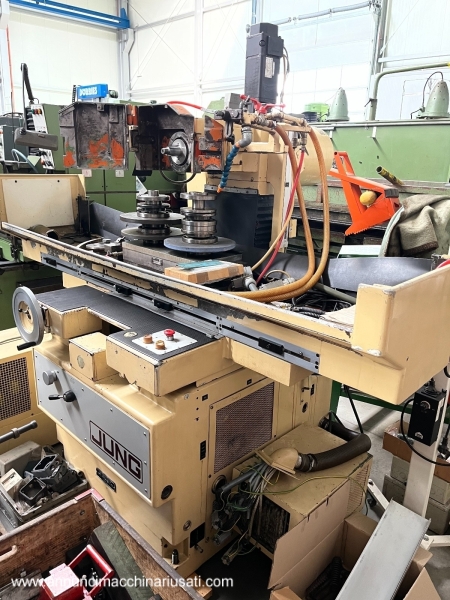
Detailed Technical Data Sheet for Jung JF 625 CNC Grinding Machine (1986)
General Description
The Jung JF 625 CNC grinding machine is a precision machine tool designed for the high-accuracy machining of flat surfaces. Built in 1986, it is still appreciated today for its solidity, reliability, and ability to deliver high-quality surface finishes. This model is equipped with the Siemens Sinumerik 810G control system, one of the first CNC (Computer Numerical Control) systems that revolutionized machine tool control, making it more precise and versatile.
Main Components
- Magnetic Chuck: Flat surface that holds the workpiece during machining using a magnetic field.
- Grinding Wheel Mandrel: Device that houses the abrasive wheel, the key element for material removal.
- Grinding Head: Component that supports the grinding spindle, allowing movement along the Z axis.
- Base: Rigid and heavy structure that ensures stability to the machine and dampens vibrations during processing.
- CNC Control System: The Siemens Sinumerik 810G, which allows for automatic programming and control of machine operations.
- Motion Systems: Linear guides and ball screws for the X, Y, and Z axes, which ensure precise and repeatable movements.
- Lubrication System: Supplies oil to moving parts to reduce wear and overheating.
Technical Specifications
- Weight: 2500 kg
- Installed Power: 2.2-9.5 kW (varies according to the operating modes and the power required by the specific job).
- Race of the Aces:
- X-axis (Length): 600 mm
- Y-axis (Width): 250 mm
- Z-axis (Height): 500 mm
- Wheel Size: Usually compatible with wheels of variable diameter depending on the job, typically from 200 to 300 mm.
- Control System: Siemens Sinumerik 810G
Workable Materials
The Jung JF 625 CNC grinding machine is designed to work hard and resistant materials, such as:
- Hardened steels
- Hard metals (e.g. cemented carbides)
- Cast iron
- Non-ferrous metals (copper, aluminum)
- Composite materials
Mechanical and Structural Characteristics
The cast iron frame of the Jung JF 625 ensures excellent mechanical stability, essential for precision grinding operations. The XYZ-axis arrangement allows for three-dimensional machining, making this machine extremely versatile for a variety of industrial applications. The guideway and ball screw system minimizes friction and wear, ensuring a long operating life.
Maintenance
To keep your Jung JF 625 CNC in good operating condition, you should follow a regular maintenance schedule that includes:
- Daily cleaning: Removal of processing residues and inspection of surfaces.
- Weekly check: Check the oil level in the lubrication system and check the guides.
- Monthly maintenance: Check belt tension, check grinding wheel condition and check joints.
- Annual overhaul: Machine calibration, checking and replacement of worn components, such as bearings and ball screws.
Checking the State of Wear
When considering purchasing a used Jung JF 625 CNC, it is important to consider:
- Condition of guides and screws: Check that there is no excessive play or signs of wear.
- Control system status: Make sure that the Siemens Sinumerik 810G is operating correctly, without software or hardware errors.
- Machine Accuracy: Perform machining tests to evaluate the machine's ability to hold tight tolerances.
- Previous Maintenance: Request maintenance documentation to understand if the machine has been cared for over time.
Sectors of Use
The Jung JF 625 CNC is mainly used in the following sectors:
- Aerospace: For grinding critical components with tight tolerances.
- Automotive: Used for finishing engine and transmission components.
- Molds and Dies: In the machining of flat surfaces of molds to ensure the quality of the parts produced.
- Precision Mechanics: For the production of high-precision components in small and medium series.
Advantages of Buying Used
- Low Cost: Buying a used machine involves a lower investment than buying a new one, making the Jung JF 625 CNC an affordable option.
- Proven Reliability: Being a time-tested machine, good results can be achieved with proper maintenance.
- Limited Depreciation: A used machine has already undergone its main depreciation, maintaining its value over time.
- Immediate Availability: Generally, used machines are available for immediate delivery, avoiding the waiting times for a new production.
Calibration and Optimization Formulas
To calculate the optimal machining parameters:
-
Cutting speed (Vc):
Vc=π×D×n1000Vc = \frac{\pi \times D \times n}{1000}Vc=1000π×D×n
Where:
- DDD is the diameter of the grinding wheel (mm)
- nnn is the rotation speed of the grinding wheel (rpm)
-
Feed rate (fv):
vf=nz×fz×nvf = n_z \times f_z \times nvf=nz××fz××n
Where:
- nzn_znz is the number of teeth of the grinding wheel
- fzf_zfz is the feed per tooth (mm)
- nnn is the rotation speed of the grinding wheel (rpm)
-
Depth of pass (ap): Determined based on the hardness of the material and the capability of the machine, often ranging from 0.005 to 0.05 mm.
Conclusion
The 1986 Jung JF 625 CNC grinding machine represents a solid and reliable solution for precision machining in various industrial sectors. Purchasing a used machine of this type can be an excellent economic choice, provided it has been properly maintained and is in good working condition.