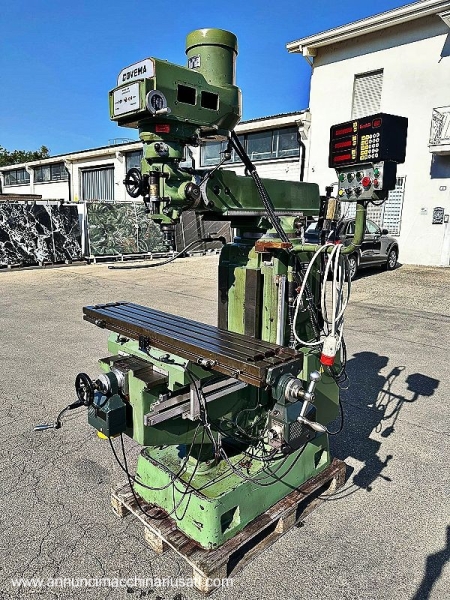
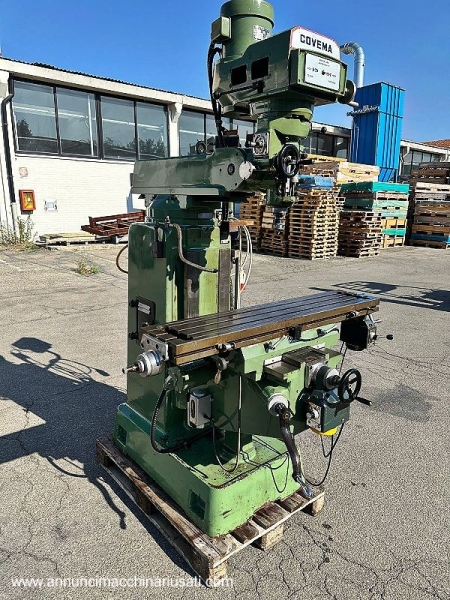
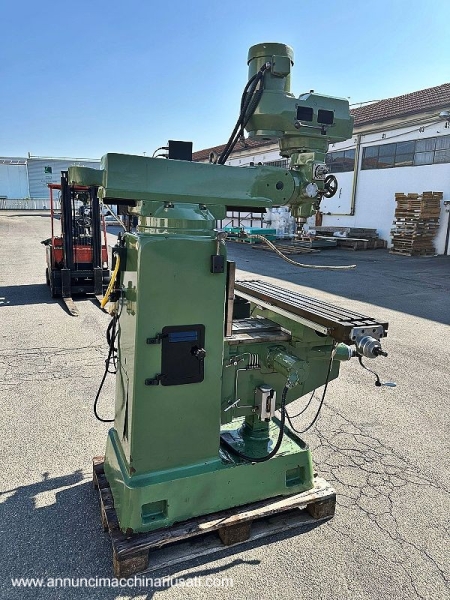
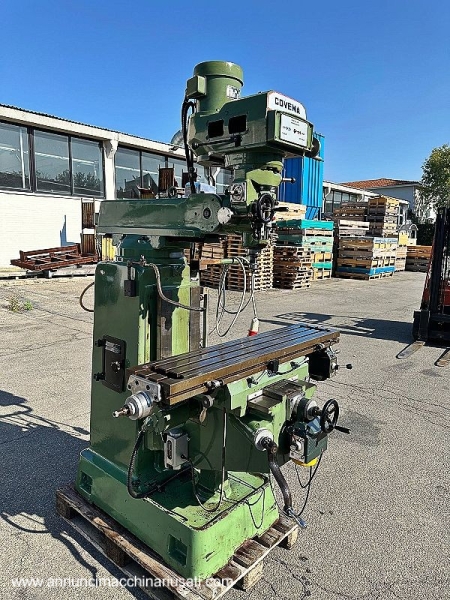
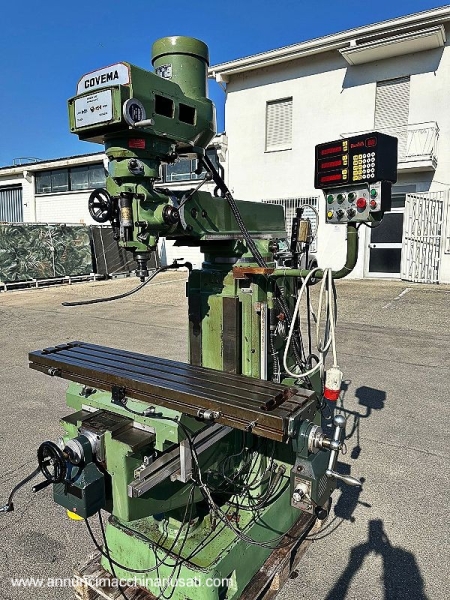
COVEMA 4 VS high-speed milling machine with 3-axis display. This milling machine is a versatile, high-performance machine tool, primarily used for milling operations on various types of materials
The COVEMA 4 VS high-speed milling machine is a machine tool designed for high-speed milling operations. It's particularly appreciated for its ability to work quickly and precisely on various materials. Here's a detailed overview of how it works, how to use it, the types of milling machines available, the materials it can be machined, the available alternatives, calculations for optimizing its operation, and the reasons why it might be worth buying a used model.
How a High-Speed Milling Machine Works and How to Use It
The milling machine uses a rotating head (called a "fast head" in the case of the COVEMA 4 VS) to remove material from a workpiece through the action of a cutting tool called a "cutter." The "fast head" designation indicates that this machine is capable of reaching very high rotation speeds, allowing for rapid and precise machining.
Phases of use:
- Machine preparation: The appropriate cutting tool (milling cutter) is mounted in the spindle of the fast head.
- Clamping the workpiece: The workpiece is clamped to the worktable, often using clamps or a mechanical fastening system.
- Parameter setting: The rotation speed of the head and the feed rate of the tool are set according to the material to be worked and the type of operation to be performed.
- Machining: The fast head rotates the tool while the workpiece is moved in the established directions to create the desired shape or profile.
- Checking and finishing: After the main processing, finishing can be performed to improve the surface quality or add details.
Types of Existing Milling Machines
Milling machines are classified mainly according to their configuration and operating capabilities:
- Vertical milling machines: The tool is mounted vertically, ideal for machining on horizontal planes.
- Horizontal milling machines: The tool is mounted horizontally, suitable for lateral machining and for workpieces requiring deep cuts.
- Universal Milling Machines: Combines the capabilities of vertical and horizontal milling machines, offering operational flexibility.
- High-speed milling machines: Designed for high-speed machining, reducing machining times and improving accuracy.
- CNC milling machines: Completely computer-controlled, they allow for very complex machining with extremely high precision.
Workable Materials
The COVEMA 4 VS is capable of processing a wide range of materials thanks to its ability to operate at high speeds, including:
- Mild and alloy steels
- Aluminum and its alloys
- Copper and brass
- Plastic materials
- Composites
- Wood (if used with specific tools)
The choice of cutting tool and rotation speed are crucial to obtaining quality machining on different materials.
Alternative Machinery
Depending on specific needs, there are various machine tools that can be used as alternatives to the high-speed milling machine:
- CNC milling machine: Ideal for complex machining operations requiring high precision and repeatability, with the option to automate the process.
- CNC Machining Center: A multifunctional machine that combines milling, drilling, and other machining operations in a single setup.
- Rotary tool lathe: Used for machining cylindrical workpieces, it can perform operations similar to milling.
- Pantograph: Used for engraving and cutting on flat and curved surfaces, mainly on wood and plastic materials.
- Grinder: Used for the machining of very precise and smooth surfaces, particularly on hard materials.
Calculations to Optimize Operation
To optimize the performance of the COVEMA 4 VS milling machine, it is important to perform correct calculations to determine the operating parameters:
- Cutting speed (Vc): Depends on the type of material and the tool used. It is calculated with the formula Vc=π⋅D⋅n1000Vc = \frac{π \cdot D \cdot n}{1000}Vc=1000π⋅D⋅n, where D is the tool diameter and n is the spindle rotation speed in revolutions per minute (RPM).
- Feed per tooth (fz): This is the distance the tool advances per tooth in one complete revolution. It depends on the material and the tool used.
- Cutting depth: It must be calibrated according to the material and the available power of the machine to avoid excessive load and wear on the tool.
Why You Should Buy a Used COVEMA 4 Milling Machine
Buying a COVEMA 4 VS can be advantageous for several reasons:
- Economic Savings: A used model offers a lower purchase cost than a new one, allowing for a more modest investment.
- Build Quality: COVEMA routers are known for their robustness and durability, meaning a used model can still provide years of reliable service.
- Availability: Used machines are often immediately available, eliminating the wait for delivery of a new model.
- Value Retention: High-quality machine tools tend to retain their value over time, making a used model a good investment even with a view to possible future resale.
- Adaptability to Needs: A used model can already be configured for specific applications, reducing the need for costly customizations.
Conclusion
The COVEMA 4 VS high-speed milling machine is an excellent choice for those requiring a versatile machine tool capable of high-speed, precise machining of a variety of materials. Purchasing a used model represents an opportunity to obtain a high-quality machine at a lower cost, while maintaining high performance and reliability. Its ability to optimize machining times without sacrificing quality makes this milling machine a valuable addition to any workshop or factory.