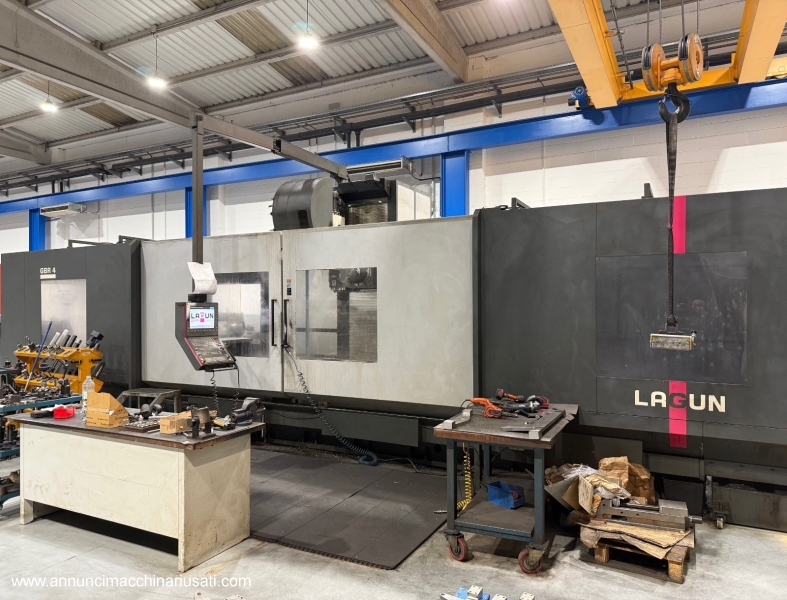
Technical data sheet – Lagun GBR 4 (used)
| Voice |
Value / Details |
| Make / Model |
Lagun GBR 4 |
| Machine type |
CNC fixed-bed milling machine (“bed-type milling machine”) |
| |
|
| CNC control |
Heidenhain iTNC 530 ( |
| Racing axes |
X = 4 000 mm; Y = 1 200 mm; Z = 1 500 mm |
| Table |
Length = 4,100 mm; Width = 1,000 mm |
| Table load capacity |
7,000 kg (max piece) |
| Spindle power |
|
| |
|
| Tool attachment |
ISO 50 / BT / MK (type) |
| Rapid axis speed |
X/Y/Z = 20 000 mm/min ( |
| Machine overall dimensions |
Length ≈ 10,100-10,900 mm; Width ≈ 4,900-5,700 mm; Height ≈ 3,200-3,800 mm |
| Machine weight |
Approximately 21-22 tons (21 000-22 000 kg) ( |
| Milling head indexing |
Automatic head 2.5° x 2.5° |
| Self-sufficient refrigeration |
Example: through-spindle coolant 20 bar, chip conveyor ( |
Technical description of the used good
Let's imagine we're evaluating a Lagun GBR 4 on the used market: as an experienced seller, I want to clearly explain why this machine represents an excellent deal, what components it comprises, how it is made, how to use it, and how to evaluate a "used" one.
Presentation and context
The machine in question, the Lagun GBR 4, is a large fixed-bed milling machine designed for machining bulky parts: machine bases, plates, heavy structures made of steel, cast iron, or special materials. The fact that it's sold used is an advantage: you can own a high-performance machine at a low cost, provided it's been well-maintained.
Visually, the Lagun GBR 4 features a solid bed frame, a very large table (4,100 × 1,000 mm), lateral columns or struts supporting the milling head, and a modern CNC system (Heidenhain iTNC 530). Its overall dimensions (machine length over 10,000 mm, weight over 20 tons) require adequate foundation, access, and space for workpiece handling. It is a "factory machine," not a small workshop machine.
Components and structure
Here's how it's made, what components it's made of:
-
Frame / bed: a sturdy cast iron or similar structure that ensures rigidity, precision and thermal stability, essential in a machine for heavy parts.
-
Worktable: 4,100 x 1,000 mm, capable of supporting workpieces weighing up to 7,000 kg. This large worktable allows for multiple fixtures, bases, jigs, etc.
-
Axes (X, Y, Z): We are talking about 4,000 mm of travel on the X-axis (movement of the table or head relative to the bed), 1,200 mm on the Y-axis and 1,500 mm on the Z-axis. This allows the accommodation and machining of very large parts.
-
Spindle/milling head: ISO 50 connection and power approximately 34.5 kW. Speed up to 3,000 rpm (or 4,000 rpm in some versions) depending on the configuration. The head can have automatic 2.5° x 2.5° indexing, which allows the milling head to be rotated for multi-sided machining without disassembly.
-
Tool changer / ATC: the specific model mentioned features a 24-station automatic tool changer (drum type), which allows for complex cycles to be machined with automatic tool change.
-
Cooling and chip removal systems: e.g., 20 bar through-spindle coolant, chip conveyor; systems required for intensive machining and heavy workpieces.
-
CNC control: Heidenhain iTNC530, which provides an advanced interface, support for 3-5 axis machining, and good programmability.
-
Auxiliary structures: guides, ball screws, axis motors, position sensors, operator panel, wiring, protections, etc.
-
Electrical system and accessories: electrical panel, automation, possible workpiece lighting, extraction/chip removal, fixing structure, rotary table if applicable, etc.
Mechanical characteristics and usage parameters
Analyzing the mechanical performance: the 4,000 mm X-travel, combined with a wide table and a load capacity of 7,000 kg, make it suitable for handling large industrial components. The 34.5 kW spindle power guarantees sufficient force for significant removal rates on demanding materials.
Mathematical formulas useful for estimating the optimal operating parameters are, for example:
-
Cutting speed (Vc) = (π × D × n) / 1000, where D = tool diameter in mm, n = rpm.
-
Feed per tooth (fz) = Vf / (z × n), where Vf = feed mm/min, z = number of tool teeth, n = rpm.
-
Power required ≈ (Vc × fz × ap × ae × Kc) / (60 × η), where ap = depth of cut, ae = width of cut, Kc = specific material strength, η = machine efficiency.
-
Table load: check that the weight of the piece + fixtures is ≤ 7,000 kg.
-
Stiffness: The bed's mass and rigid structure help minimize vibrations and deflections.
Workable materials
The Lagun GBR 4 can process a wide range of industrial materials such as:
-
Structural and construction steel
-
Cast iron
-
Stainless steel
-
Aluminum (with appropriate tools)
-
Bronze, brass
-
Composite materials or titanium (if the equipment allows it)
Thanks to the ISO 50 spindle and the available power, it is particularly suitable for heavy workpieces and hard materials.
Usage procedure (in typical use)
-
Positioning and fixing the piece on the table: check that the weight and dimensions are compatible with the 4,100x1,000 mm table.
-
Programming the workpiece in the CNC control (Heidenhain iTNC 530): define the X, Y, Z axes, tools, steps, sequences, possible head indexing.
-
Tool mounting in the ISO 50 spindle, setting parameters (Vc, fz, ap, ae) according to the material.
-
Check chip removal, cooling, chip conveying.
-
Start processing: advance, cut, quality control via probes or measurements.
-
After processing, dismantling the piece, cleaning the table and preparing for the next piece.
Matching accessories
-
Rotary or indexing tables for multi-sided machining.
-
Pallet changing systems for continuous cycle.
-
Expanded tool magazine (over 24 stations).
-
Part measuring probe in the machine.
-
Chip/extraction system, upgradeable coolant tank (e.g. up to 30 bar).
-
Additional protections, operator cabin, high efficiency lighting.
Maintenance and how to understand if it is a good used car
For a good used Lagun GBR 4 you need to check:
-
Working hours: the lower, the better (e.g., 6,000-10,000 hours are reported in advertisements). (werktuigen.pt)
-
Condition of guides, ball screws, spindle: no play, abnormal noises.
-
Check the table (flatness, absence of cracks or deformations).
-
Check refrigeration system, chip system, lubrication.
-
Check maintenance history.
-
Checking of fixing surfaces, brackets, stops.
-
If it does not have the CE marking or documents, it is necessary to verify compliance with current regulations (e.g. imported machine).
-
Actual accuracy verification: reference block test, offset verification, positioning errors.
Safety and compliance regulations
If the used batch does not already comply with current CE or European regulations, it is necessary to:
-
Check that the electrical panel has CE protections (magnetic circuit breakers, differential switches).
-
Fixed or mobile guards around the tool/chip area.
-
Safety signs, emergency stops, operator protection.
-
Check the machine documentation: manuals, declaration of conformity, data plate.
-
If not, arrange for an adjustment through an authorized body (machine revamping).
Sectors of use and why it is worth buying used
The Lagun GBR 4 is used in sectors such as:
-
Energy (foundations, turbine shafts)
-
Shipbuilding and offshore (large plates, structures)
-
Automotive and railway industry (chassis, bases)
-
Molds and presses (large machining)
-
General work on behalf of third parties on bulky pieces.
It is better to buy used because:
-
It allows you to reduce the capital invested compared to new ones, while maintaining a high production capacity.
-
Robust machines like the Lagun GBR 4 have a long service life and can give years of reliable service.
-
It can be immediately operational (after checks) with shorter waiting times than ordering again.
-
The amortization cost has already been partially borne by the previous user, which means a lower risk.
Why choose the used Lagun GBR 4
Ultimately, the used Lagun GBR 4 is a great deal if:
-
It has been well maintained, with low hours.
-
It has features suited to your piece (4,000 mm X-axis, large beams, 4,100×1,000 mm table, 7,000 kg load).
-
Your production cycle requires rigidity, mass, and the ability to perform heavy removal.
-
You can manage the space and infrastructure (foundation, handling, electrical system, refrigeration).
-
Evaluate used items carefully and check their integrity and compliance.
If you'd like, I can also look up the average used market price for the Lagun GBR 4 and compare it with similar models to see if it's currently affordable. Would you like me to do that?