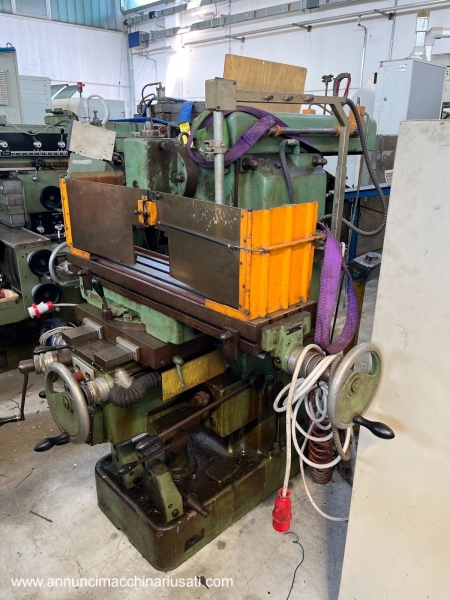
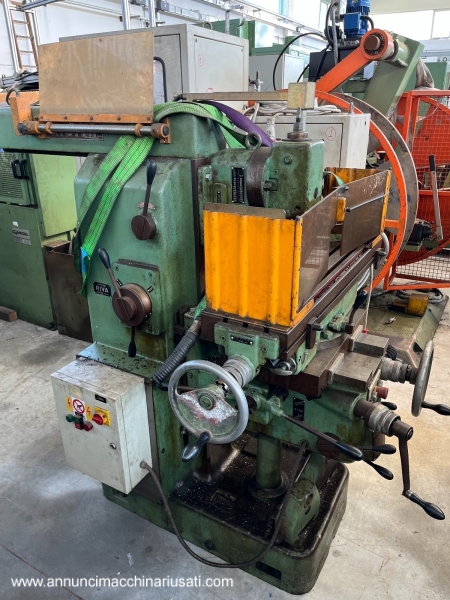
Detailed Technical Data Sheet: Used Milling Machine Traditional Type Brand Riva, Model
Overview
The used Riva traditional-style milling cutter, model, is an essential piece of equipment for working with metallic and non-metallic materials. Designed for precision and robustness, this cutter is equipped with modern safety features, such as a workbench guard and an emergency stop button, which enhance its functionality and safety.
Construction and Components
The Riva model is built with high-quality materials to ensure long life and reliable performance. The main components of the Riva model cutter include:
- Make and Model: Riva, model.
- Structure: Constructed of cast iron or steel to ensure stability and reduce vibrations during the milling operation.
- Workbench: Large and sturdy, designed to support and stabilize workpieces. Complete with guard for increased safety during work.
- Spindle: Mounted on the bench, it is the main element for the installation and rotation of the milling tools.
- Movement carriage: Allows the movement of the piece or tool along the X, Y and Z axes.
- Emergency Button: Installed to ensure quick deactivation of the machine in case of emergency, improving operator safety.
Measurements and Mechanical Characteristics
The Riva model features technical specifications that vary slightly depending on the year of construction and customizations. Typical features include:
- Workbench Dimensions: Typically 900 x 400 mm, depending on the specific model.
- Maximum Travel: The travel on the X, Y and Z axes can vary, but is typically around 800mm on the X-axis, 400mm on the Y-axis and 400mm on the Z-axis.
- Spindle Speed: Adjustable, with a range that can vary from 1000 to 5000 rpm.
- Motor Power: Generally between 1.5 and 3 kW, sufficient for a variety of milling applications.
Procedure for Use
- Preparation: Make sure the Riva model router is properly connected to the power supply and that the emergency stop button is working. Make sure the workbench and spindle are clean and free of debris.
- Mounting the Workpiece: Secure the workpiece to the workbench, using the appropriate clamping devices to ensure a secure and stable hold.
- Tool Installation: Mount the milling tool into the spindle and adjust its position and angle according to the machining requirements.
- Parameter Adjustment: Set the spindle speed and axis travels according to the type of material and the type of milling required.
- Starting Milling: Turn on the milling machine and start the milling process, guiding the tool and workpiece to achieve the desired machining.
- Inspection and Removal: After completing the milling operation, turn off the machine and remove the workpiece. Inspect the quality of the workpiece to ensure it meets the required specifications.
Matching Accessories
The Riva model can be equipped with various accessories to expand its capabilities:
- Milling Tools: Various milling heads for different applications, such as horizontal, vertical and shoulder milling.
- Clamping Devices: Clamps and brackets to secure the workpiece precisely.
- Additional Supports: To extend the working length and improve workpiece support.
- Cooling Systems: To keep the tool and workpiece at an optimum temperature during milling.
Mathematical Formulas for Optimal Use
To optimize the use of the Riva model cutter, consider the following formulas:
-
Cutting Speed (V_c):
Vc=N×D×π1000V_c = \frac{N \times D \times \pi}{1000}Vc==1000N×D×π
Where:
- NNN is the spindle speed (rpm).
- DDD is the diameter of the milling tool (mm).
-
Advancement by Revolution (f):
f=FNf = \frac{F}{N}f=NF
Where:
- FFF is the feed rate (mm/min).
- NNN is the spindle speed (rpm).
Workable Materials
The Riva model is suitable for milling various materials, including:
- Metals: Steel, aluminum, brass and other ferrous and non-ferrous metals.
- Wood: For the production of furniture components and decorations.
- Plastics: Plastic materials used in industrial and design applications.
Maintenance
To ensure the proper functioning of the Riva model cutter:
- Lubrication: Regularly lubricate the axis movements and spindle to prevent wear and malfunction.
- Cleaning: Keep your workbench and surrounding area clean to avoid the buildup of chips and dust.
- Periodic Checks: Check the wear and tear of the tools and machine components, and make sure that all safety devices are functioning.
Used Appraisal
To assess whether the Riva lathe model is in good condition:
- Check the General Condition: Check for signs of wear or damage on the main components and the workbench.
- Test Operation: Test the machine to ensure that all movements and adjustments are smooth and without abnormal noises.
- Review Documentation: Verify that maintenance documentation and safety certifications are complete and up-to-date.
Sectors of Use
The Riva model cutter finds application in various industrial sectors:
- Metalworking Industry: For the production of precision metal parts and components.
- Wood Industry: For the processing and finishing of wooden parts.
- Fine Mechanics Sector: For high-precision machining and prototype production.
Advantages of Buying Used
Buying a used Riva brand milling machine offers significant advantages:
- Lower Cost: Allows you to purchase a quality machine at a lower price than new.
- Immediate Availability: Facilitates the start of operations without long waits for production.
- Reliability: A used model, if well maintained, can provide excellent and long-lasting performance.
If you have any further questions or need more details, please don't hesitate to ask!