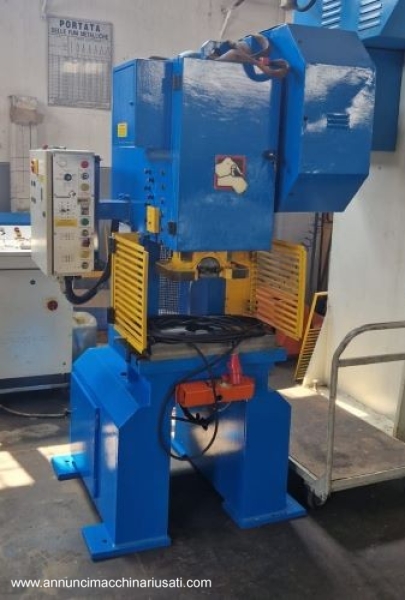
40 ton Number of connecting rods 1 Table size (xy/mm) 650 X 380 Stroke (mm) 8 - 78 Slide adjustment (mm) 60 Light at TDC*(mm) 375 Type of strokes Fixed Strokes per minute 145 Weight ( Ton ) 2.2 Height ( mm) 2110 Front ( mm) 1430 Depth (mm) 1090 Year of construction 1998 Machine conditions CE marked Model T40v
A connecting rod mechanical press is a machine used primarily in metalworking processes, particularly for stamping, drawing, bending, and shearing. Here's a detailed overview of its features:
### Parts of a connecting rod mechanical press
1. **Base**: The load-bearing structure of the machine, which supports all other components.
2. **Flywheel**: Accumulates kinetic energy and releases it during the press's operation.
3. **Motor**: Provides the energy needed to turn the flywheel and, therefore, power the pressing mechanism.
4. **Transmission System**: Includes the crankshaft and other gears that transfer energy from the motor to the flywheel and connecting rod mechanism.
5. **Connecting Rods**: Connect the flywheel to the slider, transforming the rotary motion into a linear motion.
6. **Slider (or Slide)**: Moving part that performs the vertical movement for pressing.
7. **Work Table**: Surface where the workpiece is positioned.
8. **Control System**: Command and control panel for managing the press's operations.
### Work that can be done
- **Stamping**: Forming metal parts using dies.
- **Deep drawing**: Plastic deformation of sheet metal to obtain concave shapes.
- **Bending**: Curving sheet metal or other materials.
- **Shearing**: Cutting sheet metal to obtain parts of the desired shape.
### Workable materials
- **Steel**
- **Aluminum**
- **Brass**
- **Copper**
- **Sheets of various metals**
- **Composite materials (in some cases)**
### Best brands
Some of the most well-known and respected manufacturers of mechanical presses include:
- **Schuler**: Known for high quality and technological innovations.
- **Aida**: Offers a wide range of reliable mechanical presses.
- **Komatsu**: Renowned for the precision and efficiency of its machines.
- **Stamtec**: Offers versatile and robust solutions for various applications.
- **Amada**: Famous for its high-precision and productive machines.
### Power supply of the mechanical press
Mechanical presses can be powered mainly by:
- **Electric**: The most common, where an electric motor drives the flywheel.
- **Hydraulic**: In some cases, combining hydraulic components to improve precision and strength.
### Advantages of buying a used connecting rod mechanical press
1. **Low cost**: Buying a used machine is generally much cheaper than buying a new one.
2. **Faster return on investment**: The lower initial cost allows for a faster payback.
3. **Immediate availability**: Used machines are often ready for use and do not require long waiting times for delivery.
4. **Proven reliability**: Well-maintained machines have already demonstrated their durability and reliability.
5. **Customization options**: Modifications or upgrades can be made to adapt the machine to specific production needs.
### Final considerations
Purchasing a used connecting rod mechanical press can be a strategic choice for companies looking to keep costs down without compromising quality and production efficiency. However, it's essential to check the machine's condition, the availability of spare parts, and the manufacturer's technical support.