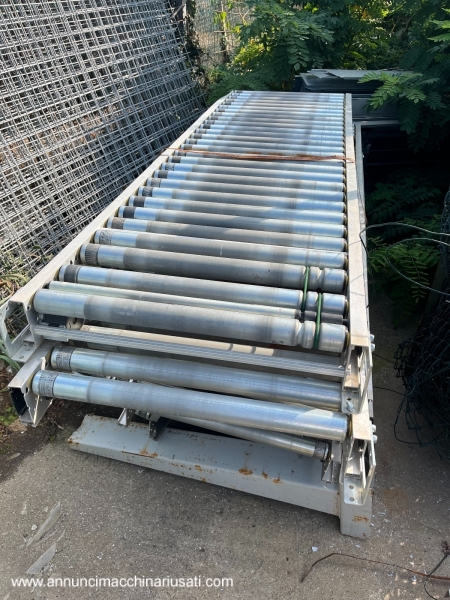
Idler and motorized roller conveyors are essential tools for moving lightweight boxes and pallets within warehouses, distribution centers, and manufacturing facilities. These roller conveyors are available in various configurations, depending on their specific use and the type of load they need to transport. Below is a detailed technical data sheet and an in-depth explanation of their features and applications.
Technical Data Sheet
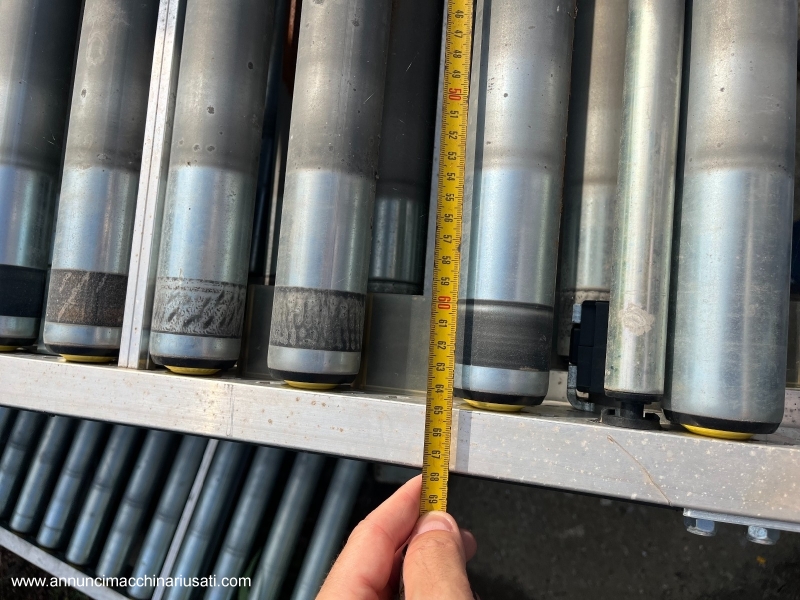
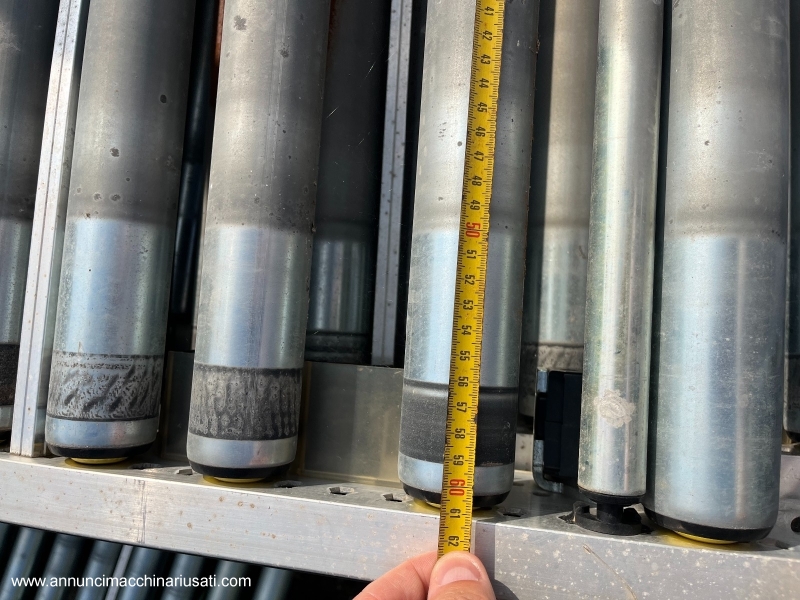
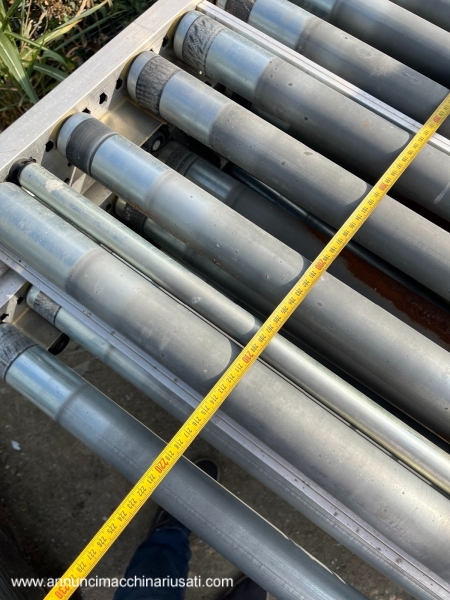
- Dimensions : 680x2100 mm
- Frame : Galvanized steel
- Rollers : Galvanized steel
- Type : Available in idle (without motor) and motorized versions
- Load capacity : Varies depending on the type of roller conveyor; galvanized rollers generally support light to medium loads
- Applications : Handling of boxes, light pallets, various materials
What are they for?
Roller conveyors are used to transport materials over short distances, facilitating the movement of goods between different areas of a facility. Idler roller conveyors rely on gravity or manual push, while motorized roller conveyors use motors to automate the movement of materials.
How are they made?
A roller conveyor consists of a sturdy frame, often made of galvanized steel to resist corrosion, and a series of cylindrical rollers that support and transport materials. Motorized versions include motors, chain or belt drives, and electronic controls to adjust the speed and direction of transport.
Parts that compose it
- Frame : The supporting structure on which the rollers are mounted.
- Rollers : Rotating elements on which materials slide; they can be made of steel, aluminum or composite materials.
- Motor (for motorized roller conveyors) : Provides the power needed to move the rollers.
- Transmission : System that transfers movement from the engine to the rollers.
- Control system : Adjusts the speed and direction of movement, especially in motorized versions.
Existing typologies
- Freewheeling Conveyors : Use gravity or manual push to move materials.
- Motorized roller conveyors : They use motors to automatically move the rollers, allowing transport over long distances or uphill.
- Chain Rollers : Suitable for heavier loads, they use chains to transfer power to the rollers.
- Belt roller conveyors : They offer quieter movement and are suitable for light and medium loads.
- Roller conveyors with curves : They allow you to change the direction of transport without changing the orientation of the load.
When to use them
Roller conveyors are ideal for industrial settings where materials need to be moved frequently, minimizing manual intervention and improving operational efficiency. Idler versions are particularly useful in environments where the warehouse layout allows for the use of gravity, while motorized versions are essential in automated production lines or for transporting materials over long distances.
Materials that work
Roller conveyors can transport boxes, light pallets, plastic containers, industrial components and other materials of weight and size compatible with the roller conveyor's capacity.
Mathematical formulas for best use
To optimize the use of a roller conveyor, it is important to calculate:
- Load capacity : Based on the number of rollers and their resistance.
- Roller spacing : Must be such that the load is always supported by at least three rollers at the same time.
- Belt speed (in motorized roller conveyors) : Determined by throughput requirements and motor capacity.
- Motor power : Calculated based on total load and desired speed.
How to choose a good used car
When purchasing a used roller conveyor, it is essential to check:
- Frame integrity : Must be free from deformation or corrosion.
- Roller Condition : Check that they turn freely and show no signs of excessive wear.
- Engine and transmission : On engine-powered versions, make sure the engine is operating properly and the transmission is not worn.
Why it's better to buy used
Purchasing a used roller conveyor is convenient because it allows you to save significantly on costs while maintaining high operational efficiency. Used roller conveyors can often be restored to near-new condition with minor maintenance.
Main sectors of use
Roller conveyors are widely used in sectors such as:
- Logistics and warehousing : For the handling of boxes and pallets.
- Manufacturing industry : For the transport of components along production lines.
- Distribution : For the efficient management of material flow in distribution centers.
Roller conveyors, whether idle or motorized, represent a versatile and scalable solution to improve material handling in a wide range of industrial applications